
10 AI Tools for Agencies: A Practical Comparison
Compare 10 AI tools for agencies across campaign operations, reporting, creative, automation, pricing, scale, and practical trade-offs.
- ai tools for agencies
- agency automation
- ad operations
- advertising AI
- marketing tools
The most popular advice about AI tools for agencies is also the least useful: pick one platform and let it handle everything. Agencies don’t have one workflow. A paid media team needs controlled execution, a search team needs repeatable QA, a creative department needs intelligence about assets, and account managers need reporting they can trust. A single dashboard rarely handles all of those jobs well, especially when the difference between spotting a problem and safely fixing it affects a client’s live budget.
This comparison organizes ten resources by the agency job they perform, including campaign execution, cross-channel management, search automation, reporting, creative analysis, and high-volume production. The important question isn’t only what each platform can see. It’s whether the tool can act, what permissions it has, how it records changes, which channels it covers, and whether its pricing still makes sense as the agency adds accounts.
Pricing is transparent for some products and sales-led for others. That difference affects procurement, margin planning, and how quickly a team can test a workflow. The tools also vary sharply in maturity. Some are built for enterprise operating layers, while others are better for a specialist managing a focused channel portfolio.
AdCrunch is a useful reference point because it takes a guarded approach to write access. It isn’t an undisputed winner, and it doesn’t try to be one platform for every agency. Its appeal is narrower and more operational: connect insight to action, restrict what an agent can change, and keep a permanent record of what happened. Agencies building video processing pipelines can also look at RenderIO’s guide to video processing pipelines when production automation sits alongside paid media operations.
Table of Contents
- 1. AdCrunch
- 2. Smartly.io
- 3. Skai
- 4. Marin Software
- 5. Optmyzr
- 6. Madgicx
- 7. Bïrch
- 8. Adalysis
- 9. VidMob
- 10. Celtra
- Top 10 AI Tools for Agencies: Feature Comparison
- Choose by Control, Coverage, and Scale
1. AdCrunch
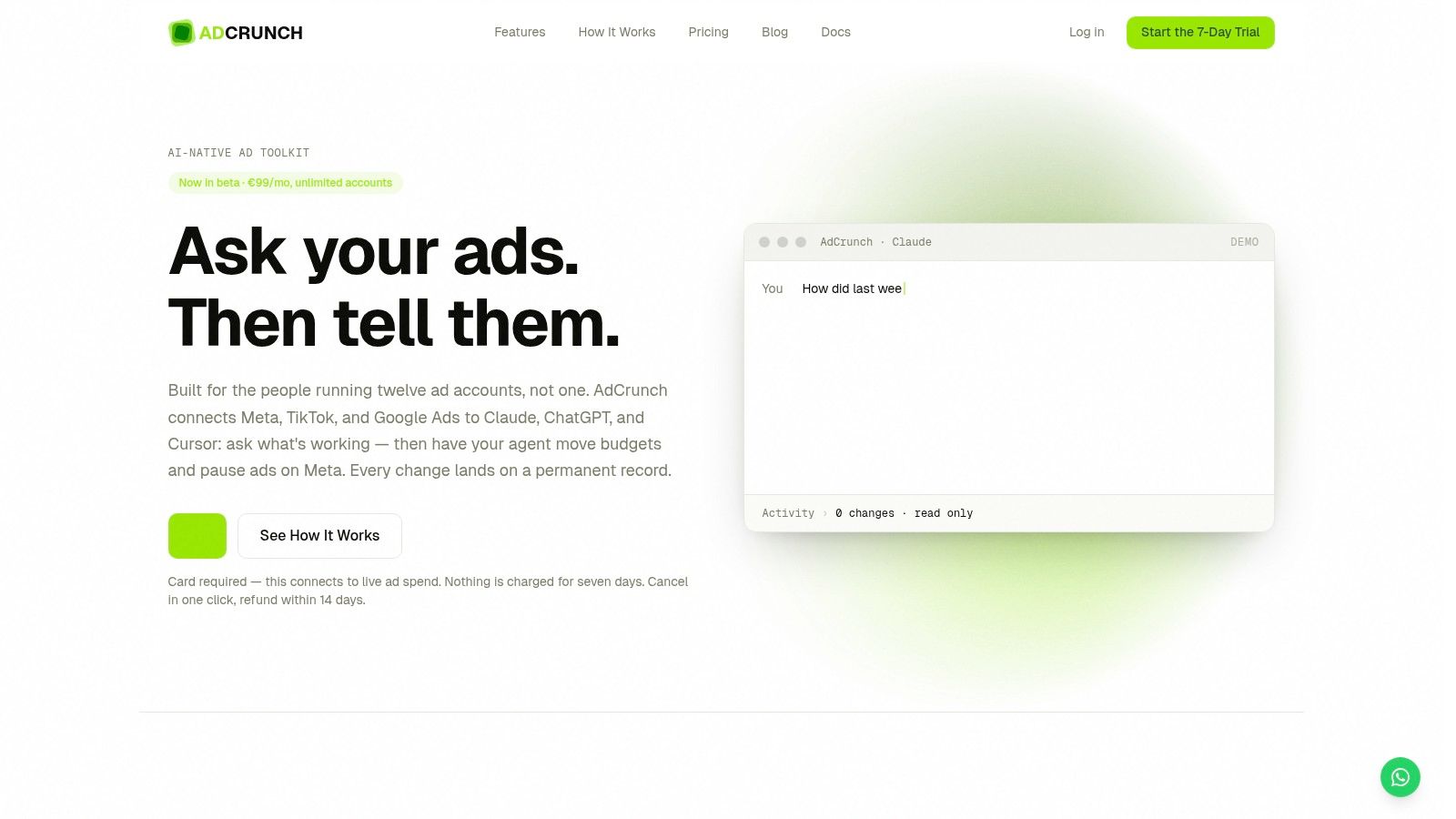
AdCrunch is designed for agencies that manage multiple advertising accounts and lose time moving between dashboards, spreadsheets, chat tools, and approval threads. It connects Meta, TikTok, and Google Ads in a consistent view, then links that data to Claude, ChatGPT, Cursor, or AdCrunch’s own in-console agent, Adgent. The practical difference is that the workflow can continue from a performance question to an operational action, rather than ending with a recommendation in a report.
Meta currently has write access. An agent can build campaigns, ad sets, creatives, and ads, adjust daily or lifetime budgets, and pause, resume, or archive entities. TikTok and Google Ads are read-only for now, so the platform is best understood as a Meta execution layer with cross-network visibility, not a fully write-enabled command center.
Controlled action is the product advantage
The strongest feature is bounded write access with a permanent record. The agent can perform a limited set of actions on Meta, but it can’t hard-delete entities, edit bids, or change targeting on existing ad sets. Anything it creates arrives paused, which gives a practitioner an inspection point before new spend begins.
Credentials stay server-side and aren’t exposed in prompts. The Activity page records the account, exact change, request origin, and outcome. That record matters when several buyers work on the same account, a client questions a budget movement, or an agency needs to demonstrate who requested an action and how it ended.
Practical rule: An agent should have the narrowest write scope that still removes the manual step you want to eliminate.
Skills and Brands let an agency encode its own ad-operations playbooks and brand guidelines. Campaign Plans turn structured line items into executable work while keeping the plan and launch synchronized. These controls are more useful than asking a general model to “optimize the account” because they preserve house rules instead of relying on the prompt of the day.
Pricing and fit
Pro costs €99 per month, with unlimited ad accounts and seats. A 7-day trial is available with a card required, and paid plans include a 14-day refund policy. Enterprise adds SSO, SLA, and custom integrations. The flat organization-level price is attractive for performance agencies, freelance media buyers, ecommerce teams, and multi-brand operators that would otherwise pay more each time they add an account or user.
The trade-off is channel depth. AdCrunch is in beta, Meta is the current write-enabled network, and additional integrations such as Snapchat and DV360 are listed as coming soon. It isn’t the obvious choice for a single-account advertiser or a team that needs every publisher to support agent-led execution today. It is a strong fit when the priority is safer Meta operations, reusable playbooks, and accountability across many accounts. See the AdCrunch platform for the current feature and access details.
2. Smartly.io
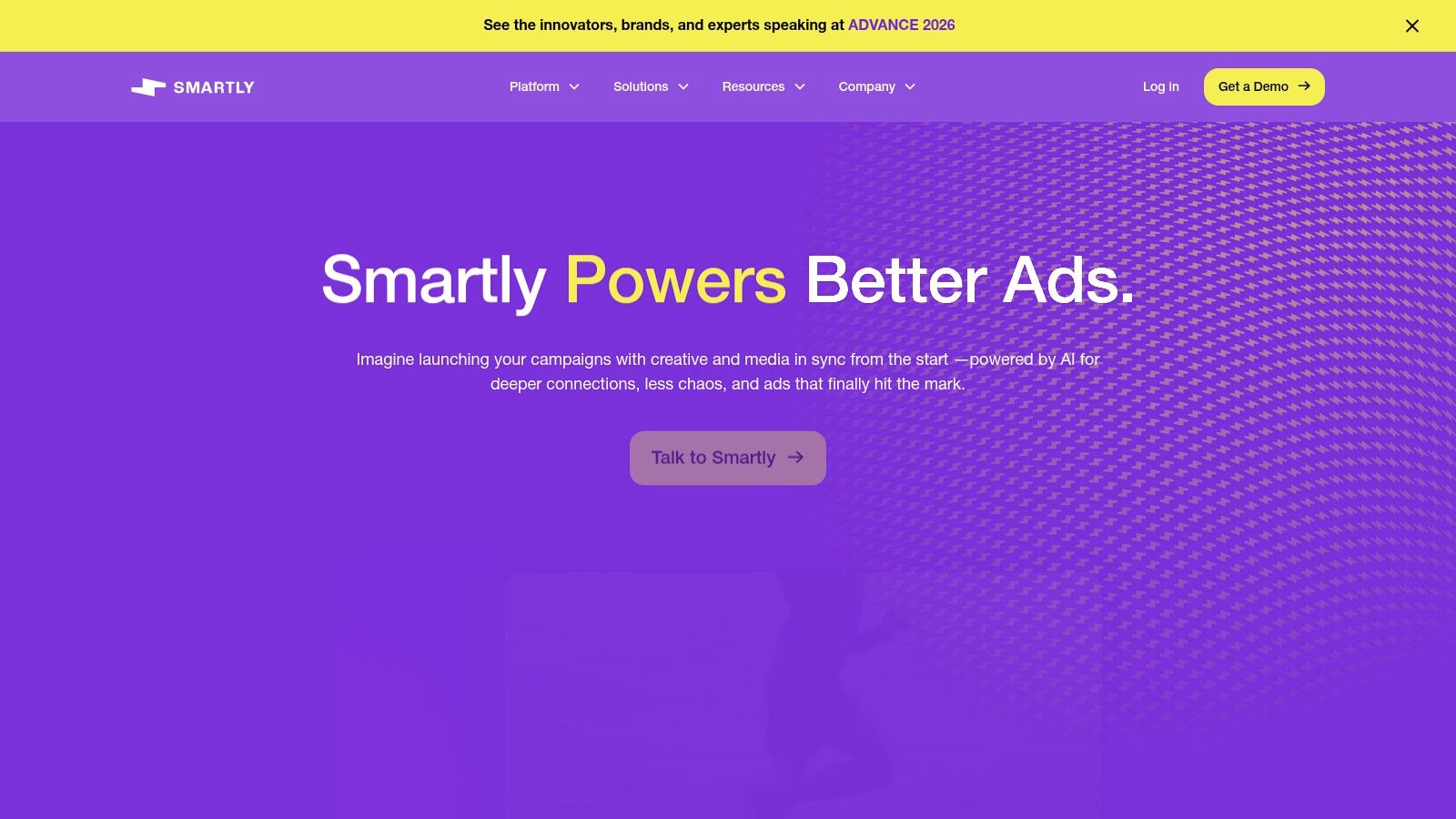
Smartly.io is the better fit when an agency’s central problem is coordinating paid social, creative production, approvals, feeds, and reporting at high volume. It brings planning, buying, creative variant generation, budget management, and measurement into one operating environment across major social publishers, including Meta, TikTok, Snapchat, Pinterest, and Reddit.
That breadth changes the buying decision. Smartly.io isn’t primarily a lightweight assistant for one media buyer. It’s a control layer for organizations that need creative and media teams to work from shared processes, with centralized approvals before campaigns go live. Its Producer workspace functions as a mission-control environment for managing production and launch workflows, while catalog and feed capabilities support repeated use of product or offer data across networks.
Strong where coordination is expensive
The platform makes sense for large creative volumes and multi-market accounts. Teams can centralize campaign creation, approvals, reporting, and pacing rather than asking each channel specialist to maintain separate processes. Predictive budget allocation and cross-channel optimization can help an agency manage media as a portfolio instead of treating each publisher as an isolated system.
Its limitation is the same feature that makes it powerful: implementation. A platform with many publishers, feeds, creative workflows, and approval paths needs ownership, naming standards, and onboarding. If an agency has a small number of campaigns and a simple production process, the operating layer may become overhead rather than an asset.
Pricing and write-access questions
Smartly.io uses custom, enterprise-style pricing, so an agency should expect a sales process rather than a public self-serve plan. That makes budget forecasting harder at the evaluation stage, and user feedback commonly raises cost as a consideration for teams that don’t have large creative or media volumes.
The platform can centralize launch controls, but buyers should still ask for a precise permission map. “End-to-end” doesn’t automatically mean every AI feature can independently change live campaigns. Confirm which actions require approval, how edits are logged, whether logs are exportable, and how the system separates creative generation from media execution. Smartly.io is strongest when an agency needs a mature, multi-market operating system and has the process discipline to support it. Explore the Smartly.io advertising platform for current publisher coverage and commercial terms.
3. Skai
Skai, formerly Kenshoo, is built around the agency job of managing paid search, social, and retail media from a shared planning and optimization layer. It targets enterprise teams that need budget pacing, algorithmic optimization, cross-channel reporting, and a common operating model across walled gardens.
The main advantage is consolidation. A large agency can use one platform and contract for multiple channel groups rather than forcing each account team to assemble a different stack. Skai’s Celeste AI is embedded in its workflows, which positions generative assistance as part of planning and optimization rather than as a separate chat window.
Good for portfolio management
Skai works best when leadership needs visibility across publishers and account teams need standardized pacing and budget controls. The platform is suited to annual planning, portfolio-level monitoring, and structured optimization where channel specialists still operate within a shared framework.
It isn’t a quick install. Enterprise onboarding, data mapping, permission design, and change management all matter. A team that only wants natural-language answers about one channel will likely find the platform too broad. The value comes from replacing fragmented operating processes, not from adding another reporting screen.
Skai’s annual pricing model is intended to make forecasting easier than a fee calculated as a percentage of spend, but the actual commercial structure and implementation requirements are sales-led. Agencies should ask whether the contract covers every needed publisher, user group, reporting requirement, and support level. They should also test the distinction between recommendations and direct changes. A system can optimize bids or budgets algorithmically while still requiring human approval for launches, and those controls should be explicit.
Auditability matters more than a clever prompt when several teams can change the same account.
For agencies comparing operating layers, the AdCrunch guide to ad account management tools provides another perspective on permissions, account structure, and operational control. Skai is a serious choice for enterprise omnichannel planning, but smaller agencies may struggle to justify the onboarding effort and sales-led pricing. Visit Skai for current capabilities and purchasing information.
4. Marin Software
MarinOne is a cross-channel performance marketing platform for agencies managing complex portfolios across search, social, retail media, and selected display and video publishers. Its focus is less on conversational execution and more on bidding, budget forecasting, spend pacing, workflow automation, and unified reporting.
That distinction matters. MarinOne is useful when an agency has established rules for account management and needs software to apply those rules consistently across a large book of business. Forecasting and pacing are particularly relevant for teams that must explain delivery against client budgets, seasonal plans, or portfolio targets.
An established layer for complex portfolios
MarinOne’s breadth is its practical strength. Agencies can bring multiple publisher types into a broader management process, then use automation to reduce repetitive monitoring and bid or budget decisions. Its longevity also makes it more familiar to organizations that need an enterprise procurement path and a structured implementation process.
The cost is flexibility at the individual practitioner level. This isn’t the kind of tool many groups can adopt casually and master in an afternoon. A successful rollout needs clean account structures, agreed business rules, reliable conversion data, and clear ownership for exceptions. Without those foundations, automation may scale inconsistency instead of removing it.
Marin Software doesn’t publish detailed plan specifics transparently, so pricing is sales-driven. That makes it important to request a complete implementation estimate, including onboarding, integrations, support, and any limits on users, accounts, or data retention. Buyers should also clarify write permissions and audit history. Algorithmic bidding is not the same as broad agentic write access, and the agency needs to know exactly which decisions the platform can make without approval.
MarinOne makes sense for a mature agency with many accounts, formal forecasting needs, and enough operational complexity to justify enterprise tooling. It is less suitable for a small specialist team that mainly needs search QA or a low-friction assistant. Review MarinOne by Marin Software before shortlisting it for a managed-service environment.
5. Optmyzr
Optmyzr is one of the clearest choices for agencies standardizing Google Ads and Microsoft Ads work across many accounts. It combines rule engines, budget pacing, alerts, campaign building, audits, and an AI assistant called Sidekick. The platform’s value comes from turning repeatable account-management practices into templates and workflows that specialists can inspect and reuse.
The Campaign Automator is useful for structured buildouts. Rather than asking an AI assistant to invent an account from a blank prompt, an agency can define the inputs, naming conventions, campaign structure, and safeguards that should govern the build. Automated audits and alerts then support ongoing QA after launch.
Search depth over channel breadth
Optmyzr is strongest for agencies whose core work is paid search. Its rule engine can enforce practical conditions such as pacing checks, anomaly alerts, and account-specific actions, while unified views reduce the need to inspect every account manually. Sidekick can help with task support and recommendations, but the platform’s main strength remains operational depth, not conversational novelty.
The learning curve is real. Agencies that only use the assistant and ignore the rule system will miss much of the product’s value. Teams need to document which rules are advisory, which can act automatically, and which require review. They also need a process for handling exceptions, because a rule that works across one account type may be wrong for another.
Optmyzr offers public pricing tiers and a free trial, which makes initial evaluation easier than with sales-led enterprise platforms. Even so, the agency should calculate the time needed to build templates and train account teams. Its network support is expanding, but it remains primarily search-focused. It isn’t a substitute for a broad social execution platform.
For search-heavy agencies, Optmyzr is a practical standardization tool with clearer entry economics than many enterprise suites. It earns a place on a shortlist when the goal is consistent account hygiene, faster buildouts, and controlled automation across Google and Microsoft. See Optmyzr for current plans and trial terms.
6. Madgicx
Madgicx is a Meta-first platform for rules-based automation, analytics, creative intelligence, and budget management. It fits agencies whose delivery model centers on Meta Ads and needs a short path from performance data to creative review and account action. That focus makes it easier to operationalize than a broad suite, but it also narrows its value for teams managing several channels equally.
Its creative intelligence scoring helps teams prioritize assets for review and iteration. Automation rules handle recurring conditions and budget changes, while connectors for GA4, Shopify, Klaviyo, and TikTok add customer and campaign context. Server-to-server tracking options support measurement where browser-only signals are less reliable.
Useful for a Meta-centered service model
Agencies already organized around Meta can learn the platform quickly. Conversational controls make routine requests easier to issue, and the modular plans include a lower-cost Automation option for teams that do not need the full feature set. That pricing structure can suit smaller performance teams, although buyers should confirm current limits and connector coverage before standardizing client work.
Write access deserves a clear operating policy. A recommendation that only informs an analyst carries less risk than a rule that changes budgets or pauses ads automatically. Use approval gates for new rules, document exception cases, and audit changes against client goals rather than accepting a sensible-looking action at face value.
The main constraint is channel balance. Google Ads management is more limited than Meta functionality, so agencies with equal search and social responsibilities may need another execution platform. Cross-channel connectors improve reporting context, but they do not provide equivalent control across every network.
A score also cannot prove creative causality. Teams still need controlled tests and human review of the offer, audience, placement, attribution, and landing page. Madgicx suits a Meta-centric specialist, ecommerce operator, or small performance team seeking speed without an enterprise omnichannel suite. It is less suitable as the sole system for a diversified agency. The AdCrunch overview of AI tools for marketers provides further context on agentic and automation tools. Check Madgicx for current plans and supported connectors.
7. Bïrch
Bïrch, formerly Revealbot, takes a rules-first approach to advertising automation across Meta, Google, TikTok, and Snapchat. Agencies use if-this-then-that logic, alerts, bulk launch tools, and repeatable strategies to apply guardrails across accounts. Its AI-assisted rule creation can help translate an operational idea into a rule, but the core value is still the rule system and its cross-platform reach.
The platform includes Explorer, Launcher, and Stage tools for scaling creative uploads and ad creation. Integrations with Slack, Sheets, Appsflyer, and Hyros connect ad operations to the communication and measurement tools an agency already uses.
Broad automation with a spend-based trade-off
Bïrch is attractive when an agency wants one automation philosophy across several paid media platforms. A team can create conditions for underperformance, pacing, alerts, or launch preparation, then apply those workflows across client accounts. The approach is more predictable than asking a general-purpose model to improvise every decision.
The major commercial drawback is that pricing scales with connected ad spend. That may be easy to justify for a small portfolio, but it can become less attractive as an agency grows or manages high-spend accounts with tight margins. A buyer should model the fee against managed-service revenue, not just compare the starting plan with other tools.
Bïrch also deserves a careful permission review. Rules can act quickly, and the agency needs to know whether each action is reversible, how failures are surfaced, and what the audit log records. Slack alerts are useful for awareness, but an alert isn’t the same as a permanent change record with request origin and outcome.
Bïrch is a sensible choice for agencies that value cross-platform rules and transparent pricing mechanics more than natural-language execution. It is especially useful for always-on guardrails and bulk operations, provided the spend-based model fits the agency’s economics. Visit Bïrch to review the current agency plans and trial options.
8. Adalysis
Adalysis is a search QA and testing tool for agencies working across Google Ads and Microsoft Ads. It runs automated daily audits with more than 100 checks, supports RSA asset analysis, monitors budgets, and provides structured A/B testing workflows for text and image ads.
That makes it different from a general AI assistant. Adalysis is built to find known classes of account problems repeatedly, across multiple accounts, without waiting for a specialist to remember which checks belong in a weekly review. Its testing framework also gives agencies a clearer process for separating an actual experiment from an informal before-and-after comparison.
A QA layer for search teams
Cross-account overviews and customizable alerts help team leads identify issues before they become client-facing reporting problems. Auto-resolve options can remove selected classes of repetitive work, but they should be introduced gradually. The agency needs to understand exactly what each resolution changes and whether the change is appropriate for every account in the rule’s scope.
A search audit is only valuable when the team can trace the finding to a review, action, or documented exception.
Adalysis uses spend-based pricing, supports many linked accounts, and offers a free trial. That structure can work well for agencies with a broad account base, although spend-linked fees need the same margin analysis as any variable platform cost. Its narrower channel coverage is a feature for specialists and a limitation for omnichannel teams. It focuses primarily on Google and Microsoft Ads, so it won’t replace a cross-network media operating layer.
The product is a strong choice when the agency’s bottleneck is account hygiene, structured testing, and daily QA. It is not the right answer when the main need is agent-led campaign execution on social platforms. Teams comparing the category can use the AdCrunch guide to ad-ops tools to frame the difference between monitoring, automation, and controlled write access. Explore Adalysis for current audit coverage and pricing.
9. VidMob
VidMob addresses a different agency problem: understanding which creative elements contribute to media performance. Its platform uses AI-driven analytics to tag and score creative frame by frame, connect those attributes to ad results, and benchmark assets against platform-specific best practices.
That capability is valuable when an agency has many videos, statics, formats, creators, and markets but lacks a reliable language for discussing why one asset works better than another. Instead of reporting only that an ad performed well, a team can investigate its composition, messaging, pacing, visual treatment, and other tagged elements.
Creative intelligence rather than media execution
VidMob’s enterprise strength is the connection between creative decisions and performance data. Integrations and connectors can help bring those signals into the wider marketing workflow, while optional services such as Influencer Intelligence and an MCP connector extend the platform beyond asset scoring.
The limitation is important. VidMob is stronger at creative-quality analytics than at changing campaigns, moving budgets, or managing publisher permissions. An agency still needs a media execution platform and a clear process for turning creative findings into new briefs, variants, tests, and launches.
Pricing is typically enterprise and sales-led. That can be justified for large brands or agencies that produce enough creative to benefit from systematic analysis, but it may be excessive for a small team with a limited asset library. During evaluation, ask how the platform handles taxonomy design, data integration, user permissions, benchmark selection, and exportable evidence. A creative score is only useful when the team can understand its basis and act on it.
VidMob is the right shortlist candidate when creative performance is the bottleneck, especially across multiple brands and markets. It is not a replacement for an ad-operations tool. Learn more about VidMob and request a workflow demonstration that includes the agency’s own creative taxonomy.
10. Celtra
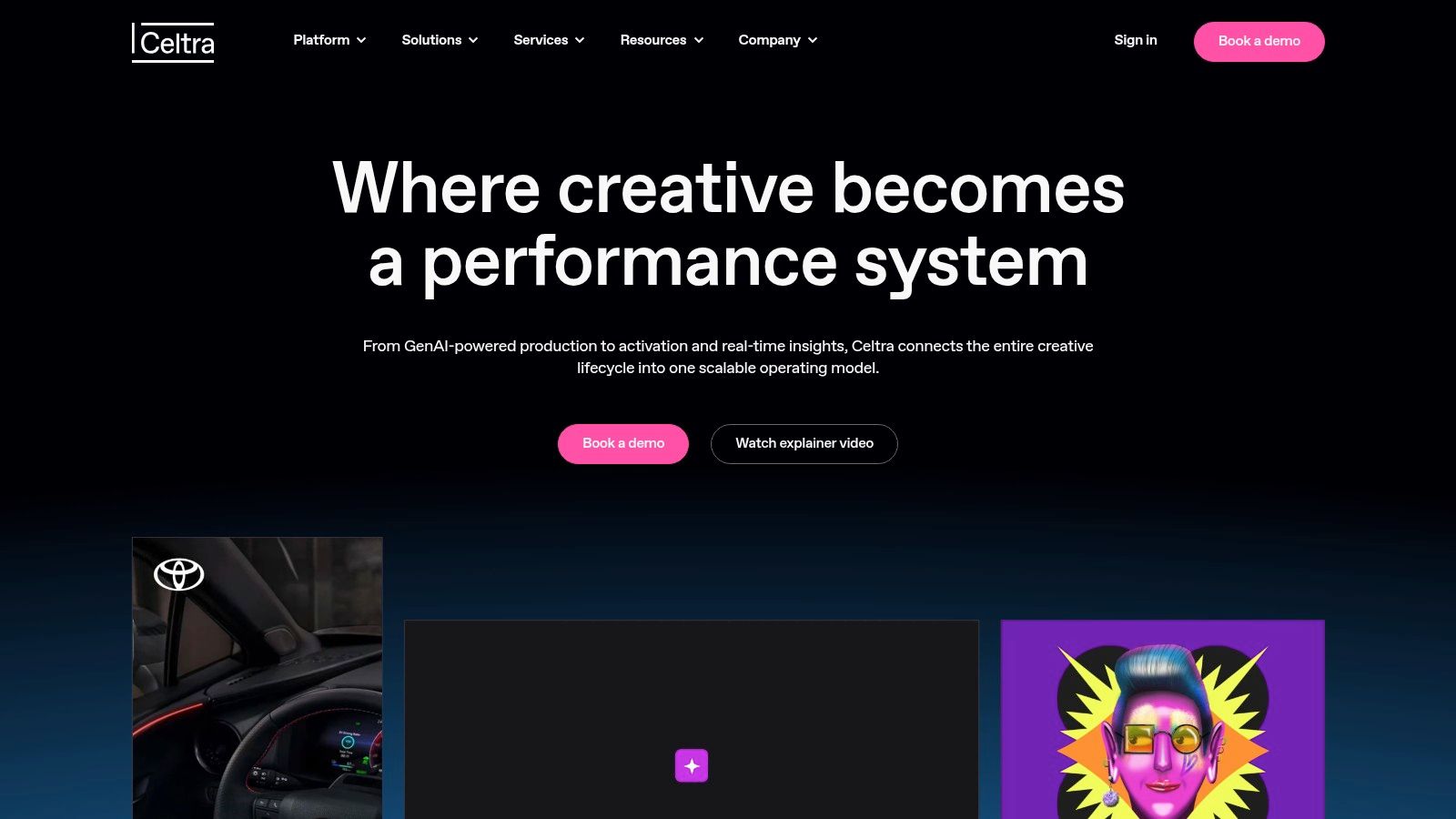
Celtra is built for high-volume creative production, localization, templating, and dynamic creative optimization. It helps large teams generate and manage many on-brand variants across markets and placements while preserving governance, approvals, and collaboration.
Its strongest use case is not “make one ad faster.” It is maintaining a production system when an agency must adapt creative for different languages, audiences, products, formats, and media requirements. Brand-governed templates can reduce the risk that a rushed variation breaks visual or messaging rules, while integrations with media platforms help move approved variants toward activation.
Governance at production scale
Celtra’s collaboration and approval features are as important as its AI-assisted production. High-volume versioning creates operational risk if no one can identify which template, input, locale, or approval produced a final asset. A governed workflow gives creative and account teams a shared point of control before variants reach paid media.
The product is custom-priced and sales-led. Its economics make the most sense for agencies and brands with substantial multi-market production needs. A low-volume team may spend more time configuring templates and governance than it saves in production.
Celtra also doesn’t solve media optimization by itself. It can pair well with Smartly.io, Skai, MarinOne, or a specialist execution tool, but the agency must define where creative approval ends and campaign action begins. That boundary should include naming, version tracking, rights management, and audit ownership.
Celtra is the best fit in this list when the agency’s constraint is the production and governance of many creative variants. It is a poor fit for a small account team seeking a simple copy assistant or a direct campaign operator. Visit Celtra to assess whether its production workflow matches the agency’s actual asset volume and market complexity.
Top 10 AI Tools for Agencies: Feature Comparison
| Product | Core features ✨ | Execution & Safety ✨ | Value & Pricing 💰 | Target 👥 | Quality ★ |
|---|---|---|---|---|---|
| AdCrunch 🏆 | Unified cross-network view; LLM connectors; Playbooks & Campaign Plans; permanent activity log | Meta write (campaigns, budgets, pause); TikTok/Google read-only; server-side creds; no hard-deletes; creations start paused; full audit trail | 💰 €99/mo flat (unlimited accounts & seats); Enterprise (SSO, SLA) + 7‑day trial | 👥 Agencies, multi-account teams, media buyers, growth ops | ★★★★☆ |
| Smartly.io | End-to-end paid social + creative production; feed/catalog mgmt | Multi-network campaign creation, predictive budget & pacing; centralized approvals | 💰 Enterprise pricing (sales-led) | 👥 Large brands, enterprise creative/media teams | ★★★★★ |
| Skai (Kenshoo) | Cross-channel planning & reporting; Celeste GenAI | Cross-channel execution (search, social, retail); budget pacing & optimization | 💰 Annual tiers (enterprise) | 👥 Enterprise agencies, global brands | ★★★★★ |
| MarinOne | Bidding algorithms, forecasting, workflow automation | Algorithmic bidding & cross-channel spend pacing | 💰 Sales-driven enterprise pricing | 👥 Agencies with large account portfolios | ★★★★☆ |
| Optmyzr | Rule engines, Campaign Automator, Sidekick AI | Strong Google/Microsoft execution; automated audits & alerts | 💰 Clear public tiers + free trial | 👥 PPC agencies and search specialists | ★★★★☆ |
| Madgicx | Meta-first automation; creative intelligence scoring; connectors | Deep Meta automation & budget rules; server-to-server tracking options | 💰 Modular plans (incl. low-cost Automation plan) | 👥 Meta-centric agencies & small teams | ★★★★☆ |
| Bïrch (Revealbot) | Advanced IF-THEN rules; Stage/Launcher for bulk launches; AI-assisted rules | Cross-platform automated rules; bulk launch & staging tools | 💰 Spend-based pricing slider (agency plans) | 👥 Agencies scaling automation across channels | ★★★★☆ |
| Adalysis | Always-on audits (100+ checks); A/B testing frameworks | Audit-driven alerts, auto-resolve & structured tests (search-focused) | 💰 Spend-based pricing; free trial | 👥 Search agencies, QA/test teams | ★★★★☆ |
| VidMob | Frame-by-frame creative analytics; creative scoring & benchmarks | Creative intelligence & recommendations; limited direct media execution | 💰 Enterprise-priced (sales-led) | 👥 Brands & creative teams focused on creative ROI | ★★★★☆ |
| Celtra | Creative automation, templating, localization & DCO | High-volume variant production with governance & approvals | 💰 Enterprise (sales-led) | 👥 Enterprise creative & localization teams | ★★★★☆ |
Choose by Control, Coverage, and Scale
The right choice depends on the job the agency needs to improve, not on which vendor uses the most ambitious AI language. Start by separating insight, recommendation, automation, and write access. A platform that identifies a weak ad is useful. A platform that suggests a budget change is more useful. A platform that can make the change safely, explain who requested it, and preserve the result has a different operational role.
AdCrunch is the strongest recommendation when the priority is guarded Meta execution. Its write scope is intentionally limited, new items start paused, and it doesn’t permit hard-deletes, bid edits, or targeting changes to existing ad sets. The permanent Activity record, Skills and Brands, and Campaign Plans make it suitable for agencies that want reusable playbooks and accountability across many accounts. Its flat €99 per month Pro pricing with unlimited ad accounts and seats is also unusually straightforward for agencies that expect account or team growth. The limitation is equally clear: TikTok and Google Ads are read-only today, and the product is in beta.
Choose Smartly.io, Skai, or Marin Software when the agency needs a broader enterprise operating layer. Smartly.io is the most natural fit for organizations combining creative production, approvals, paid social, feeds, and reporting. Skai suits portfolio-level management across search, social, and retail media. MarinOne is appropriate for complex performance portfolios that need bidding, forecasting, pacing, and workflow automation. These tools bring breadth, but they also demand more onboarding, process ownership, and commercial scrutiny.
Search-heavy agencies should look first at Optmyzr or Adalysis. Optmyzr offers deeper workflow automation, templates, campaign building, and Sidekick support for Google and Microsoft workflows. Adalysis is the more focused QA and testing choice, with recurring audits, structured experiments, budget views, and alerts. Neither should be judged by social execution criteria because search standardization is their core value.
Madgicx and Bïrch suit agencies that want rules-led automation. Madgicx goes deeper into Meta, creative intelligence, connectors, and Meta-oriented budget operations. Bïrch offers broader platform coverage and a clearer rules-based model, but its spend-based pricing deserves careful margin analysis. Both can reduce repetitive work, but neither removes the need to define safe conditions, review exceptions, and document ownership.
VidMob and Celtra solve creative bottlenecks rather than general media operations. VidMob is the stronger choice when the agency needs to connect creative attributes to performance and improve the quality of its briefs and iterations. Celtra is better for governed, high-volume versioning and localization across markets. Their value rises with creative complexity, not with the number of users.
Before signing a contract, compare channel permissions, approval processes, audit requirements, pricing basis, onboarding effort, and the number and maturity of accounts the agency manages. Ask every vendor to demonstrate a controlled pilot using realistic account structures. Test a read-only diagnosis, a proposed action, an approved action, a rejected action, and a rollback or exception path. Review the resulting logs with the person responsible for client accountability, not only the person who will use the interface.
The market is moving beyond dashboards that merely describe performance. Forrester research reported that 91% of U.S. advertising agencies were either already using generative AI or actively exploring use cases, with larger agencies adopting it more often than smaller ones, as reported by Marketing Dive’s coverage of the Forrester study. That adoption makes operational design more important, not less. Agencies need to decide where an agent may read, recommend, prepare, or act, and then make those boundaries visible to clients and internal teams.
The practical question isn’t “Which AI tool is smartest?” It is “Which tool can remove this specific manual step without creating a larger control problem?” Select the narrowest platform that solves the bottleneck, connect it to a documented workflow, and expand permissions only after the team can explain every automated outcome.
AdCrunch gives agencies a cross-network view across Meta, TikTok, and Google Ads, plus guarded Meta execution through Claude, ChatGPT, Cursor, or Adgent. If you need reusable playbooks, paused creations, and a permanent record of every change across multiple accounts, visit AdCrunch and test whether its flat pricing and controlled write access fit your operating model.